Tuesday, October 18, 2011

Nicholas Financial: Quality on Sale

I recently added to my previously held position, Nicholas Financial (NASDAQ:NICK), at $9.74. Nicholas is in the business of making sub-prime auto loans.

Contrary to the business description, it is one of the highest quality financial that I have come across - it has continued to stay profitable over the past decade consistently doing Returns on Average Equity (ROAE) of 10% to 15% (with the exception of 2008 when ROAE dropped to 6%), despite this period being one of the worst for financials since the depression. It is one of the few financials that continues to grow in this dismal environment of poor loan demand and does not face as big a risk of net interest margin compression as the conventional banks.

At current valuations, the upside is of 70% to 150% over the next 5 years, or an IRR of 11% to 20%. Add to this a dividend yield of 4%, you get a very compelling IRR of 15% to 24%, and a very limited chance of permanent loss of capital, thanks to its conservatively reported book value of $10 per share.

For a full write up, I recommend you read my submission for Gurufocus' October Value Contest here

Sunday, August 21, 2011

2011 Portfolio Update

This is first post in four months since my write-up on CVS Caremark. Yes, I am still alive and kicking. I have been very busy in the past few months learning about the banking and insurance business, researching for new ideas, and writing new ideas at www.valueinvestorsclub.com (VIC). Unfortunately, writing on the blog fell to the bottom of my list of things to do.

For those who are unfamiliar with VIC, it is an exclusive forum of only 250 value investors who share long and short ideas on the forum.  The club was started by the renowned author and hedge fund manager Joel Greenblatt. To be selected to the club, one writes up a “deeply researched” long or short position to be judged by a panel of VIC judges. I got selected to the club based on my write-up on MasterCard. I feel extremely fortunate to be part of the club – in less than 6 months I feel like I have learnt more than I ever have in my investing career by interacting with one of the smartest groups of value investors out there. One of the restrictions of VIC is that ideas posted there cannot be shared publicly. Unfortunately it means that, going forward, ideas that I post there or I learn of there will not show up in much detail on this blog.

Uncertainty and volatility has returned to markets. Correlation between asset classes has increased dramatically and almost all investing decisions today seemed to be made on increasingly short time horizons. The prevalence of algorithmic trading has reduced the already short-termed nature of a large number of market participants to holding periods of minutes, if not seconds! The only thing I know I will be doing is what I know to do – buy good businesses that are low in leverage, have low risk of obsolescence, and are offered by Mr. Market at an attractive price. Undoubtedly, this will be accompanied with a mark down in market prices of businesses we own today and will own through this environment. I will not let this bother me much since I continue to be confident that Ben Graham was right when he said “Mr. Market is a voting machine in the short-run, and a weighing scale in the long-run.”

Next, I want to talk about the portfolio’s performance. Even though portfolio’s YTD performance has beaten S&P500, it has been dissatisfactory to say the least – portfolio -6.8% YTD compared to S&P500 (with dividends reinvested) -10.39% YTD. To congratulate oneself based on comparisons with other indices is idiotic, since we do not eat from the plate of relative performance. Looking at a more longer horizon, the portfolio held up much better, +12.15% cumulative growth since 1/1/2010 relative to –0.52 cumulative growth in S&P500 (with dividends reinvested) since 1/1/2010. My longer term goal is to have the portfolio CAGR at inflation plus 10%.

CumulativeGrowth-8192011

Let me update you on the changes in the portfolio from the last time I reported. I sold out of four positions – three of them had reached their “intrinsic value” and the forth one, FUR,  I was wrong on and sold at a reasonable profit.

PositionsSold-8192011

FUR is structured as a REIT – meaning it has to pay out a large portion of the FFO to the owners – causing the REIT to keep coming back to the capital market every time it wants to grow. FUR had become a 25% position in my portfolio, and the only way I could stay undiluted was to participate in the capital raise. I was super uncomfortable with a position larger than what I already had. The reason for selling out had more to do with the function of a REIT in my portfolio rather than Mr. Ashner’s skills, who is one of the smartest real estate investors I have come across. If the price becomes right, I may start a very small position again in the future.

Now, let me turn your attention to the current positions in the portfolio.

CurrentPositions8192011

Note: Foreign holdings such as Accor and Edenred have been converted to USD on a mark to market basis. The Gains % column indicates gains in market value of the security including dividends yielded since the time of purchase of the security.

I will make a comment on my thesis on each of the holdings starting with a long comment on the ones that had the largest negative impact on the portfolio and a short one on the ones that have had the largest positive impact. I believe that we learn more from our “failures” than our “successes.” (All of the above is just mark to market – so failures and successes have limited meaning).

Kirkland’s (KIRK) – I initiated my position in KIRK, a specialty retailer, in Nov 2010 when it got really cheap (2x EV/EBITDA) due a couple of factors – gross margin compression due to higher than expected discounting and promotional activity, and operating margin compression due to deleverage caused by falling same-store-sales. The closest comp, Pier 1 (PIR) was trading at 5x EV/EBITDA. My wife and I have been shopping at KIRK since the time we bought our home a few years ago, so I was familiar with their concept. I viewed their problems more short term in nature and viewed this as a 2x given that KIRK had a long runway in front of it as it expanded its store count. KIRK has about 300 stores whereas Pier 1 has about 1200 stores, so it wasn’t unreasonable to assume that KIRK could get to 400-500 stores by 2015, as long as the economy remained somewhat stable. KIRK moved up by 30% in less than a few months, but I didn’t sell out, because I viewed it as a compounder over the next 5 years. Mistake #1 – valuation is not an exact science, hence the need to invest using a margin of safety. I should have taken 30% gains and got out. KIRK was back to where I started my position by the time it reported next quarterly results. Old issues (which I viewed as temporary) were still a concern but no new issues came up on the call other than a slow down in growth of new stores due to difficulty in finding new locations. KIRK management was now projecting growth of 20 net new stores in 2011 rather than 40. 20 new stores still got you 100 new stores in 5 years. My thesis remained intact, so I doubled up on my position. Mistake #2 – I should have nibbled at it, rather than doubling up. A small store like KIRK has massive operating leverage at work, so a lot of little issues can cause major swings in their margins (even though they may be temporary) causing volatility in the stock price as the street is focused on those little things. The volatility meant that I could have added to my position as it went down, and if it didn’t go down I still had a reasonable sized position to get a good enough upside. There was no reason to double up on one shot. A few weeks later, KIRK was down 25% primarily due to macro concerns. Today, KIRK is insanely cheap – EV of 85M, fortress balance sheet with no debt, and a EBITDA ranging from 30-60M in 2008-2010. KIRK reported its quarterly results on Aug 19, 2011 and nothing much has changed business wise. They are working through their issues – by changing merchandise mix to help lower the promotional activity and stabilize same-store-sales. They also announced that they will be using 40M of excess cash on balance sheet for buybacks in the next 18 months. When the stock is so cheap and the issues are temporary, use of excess cash to do buybacks is highly accretive to the shareholder. 40M of cash at today’s price will buyback 25% of their outstanding stock! Even if net income does not grow from 2011E of 20M, EPS grows from by 33% from $1 to $1.33. If they fix their issues in the next 18 months, Mr. Market will come back and award KIRK with the multiple it deserves of 10x – $13. In addition they will have generated another 30M or $2 of cash by then. So, conservatively we should see it go back to $13-$15 in 18 months – an IRR of 16% from my cost basis, or if you are starting a new position an IRR of 40% from today.

POSCO (PKX) is a one of the lowest cost producers of steel in the world based in Korea. It is the third largest in terms of production, and among the most profitable, if not the most. In an industry that is highly cyclical, it has achieved the rarity – consistently earned returns above the cost of capital for over a decade. In 2010, it reported one of the lowest margins in the last decade due to weakness in steel prices and increase in raw material costs. POSCO is taking the right steps to lower its raw material costs, so I am expecting that margins will eventually revert to mean. In my estimate, POSCO (ADR) is worth about $150 – 40% higher than my cost basis and 70% higher than today. Not baked into this valuation is a free option on India growth. POSCO has in-plans the largest foreign direct investment of 12B USD in India to create a FINEX plant with 12M capacity in the state of Orissa. FINEX is POSCO’s proprietary technology of steel making that can operate at 15% lower operating costs and 20% lower capex than traditional blast furnace.

With the new macro concerns surfacing, if we do double dip into a global recession, steel demand will continue to stay weak putting pressure on margins. Margin reversion-to-mean will take longer than I originally thought (five years instead of three) lowering my IRR in POSCO from 11% to 7%. My mistake on this position was one of incorrect sizing – even before the dip of 17% - at my cost basis, I was expecting a low double digit IRR which clearly did not justify a 8% position in the portfolio. I wonder now what I was thinking when I picked such a large position size! If POSCO goes back to my cost basis, I will reduce my position size. I will add to this position only if it goes below $50 (to bring my cost basis to $75 and an expected IRR of 15%).

Look for the second part of this post for comments on the next 4-5 positions, hopefully by the next weekend.

Friday, April 22, 2011

CVS Caremark: Toll Booth on Prescription Drug Spending Highway

CVS Caremark (NYSE:CVS) is the newest position in the portfolio. The position was initiated at an average cost of $33.50 and now occupies 8% of the portfolio. It represents the largest purchase since the Leucadia purchase in July 2010 resulting from a very deep analysis of its business and industry dynamics. My wife thought I was getting ready to take some exam during my research, because I spent non-stop six days a week staying up till 4:00 am for about a month.

CVS Caremark operates the largest retail drug store and the second largest PBM (prescription benefits manager) in the nation. It is the largest purchaser of prescription drugs in the world making it the Wal-Mart of the prescription drug supply industry.

To understand briefly on why this position was initiated, refer to the Summary section of my report at www.gurufocus.com (submitted for their monthly Value Contest). 

The full-report is also published at the link above, but to go through the report in its entirety, you will need patience along with a cup of coffee. The 40 page long report may seem over-the-board to some people, but when you purchase a stock, somebody else is on the other side of the trade, and only one of you can be right. It better be you if you are putting 8% of your net worth into the purchase.

Thursday, March 10, 2011

Wendy's/Arby's: Business Analysis & Valuation

Recently, I initiated a position in Wendy's/Arby's (NYSE:WEN) at an average cost of $4.79. WEN is led by the activist investor Nelson Peltz. He is well known for his ability to turnaround under-performing businesses by forcing changes that help improve operations. At the price WEN was purchased, the risk/reward profile is very attractive, especially in a frothy market like today where value has become very difficult to find. The downside is close to 0% and the upside is in the range of 35-50%. 

For a full report on WEN, refer to my article at www.gurufocus.com. For those who are not familiar with this website, it is well known among the value investing circle as a valuable resource for tracking activity of top value managers. This article was written as my contribution for a monthly contest that they run for best value ideas.

Saturday, January 1, 2011

Annual Report: Looking Back at 2010

2010Performance

This article is an update on 2010 performance of my investment portfolio. If you curious about why I update this on a public forum, you can read my reasoning in the Sept 2010 semi-annual report.

The equity portion of the portfolio was up by 22.58% relative to beginning of 2010. Accounting for cash & cash equivalents, portfolio was up by 20.37%. These numbers are net of all broker commissions and expenses. In comparison, in the same time-frame, S&P500 was up by 12.78% , Gold was up by 31.41%, and BSE Sensex was up by 17.43% (excludes costs of investing in the asset class). Really the closest comparison is S&P500, but I picked others simply because the masses are excited about these classes today. I believe that the portfolio’s performance was achieved with lower overall risk compared to any of these other asset classes, since the positions in the portfolio were purchased at an average discount of 30-60% of its intrinsic value and the portfolio maintained 10-20% cash through the entire year. I am not sure if one could say the same about the other asset classes. At the end of the year, cash dropped to 10% as a portion of cash was put to work in two new ideas in Nov & Dec.

Kirklands was purchased at an average cost of $12.10 at a surprisingly low valuation of Enterprise Value to EBITDA (EV/EBITDA) ratio of 2x. Kirklands fell from a high of $25 to $10 due to undue concerns about rising shipping costs and fall in margins. Its closest competitor Pier 1 Imports traded at EV/EBITDA of 6x at the time of purchase. Kirklands has one of highest inventory turnover in the industry and is one of the lowest cost provider.

MasterCard was purchased at $225. You can read the extensive analysis of MasterCard that was conducted before putting the cash to work in this position. This is typical of the process that I follow before investing in a specific idea. 

2010Top10

Frankly, I have mixed feelings despite the ‘market-beating’ performance of the portfolio. I am happy that it did so well, but I am surprised it happened so soon. When these positions were established in the earlier part of 2010, I had prepared myself to be patient for 1-3 years for 15-20% performance. Now with the price for many of these positions hovering around fair value (Leucadia, Ensco, Accor, Edenred), the margin of safety of holding them is much lower. This situation creates a bit of a challenge in terms of portfolio management. Since its been less than a year, selling them now would force the portfolio to part away with 30% of the gains to Uncle Sam. Giving away 30% of the gains would reduce the net gain of the portfolio from 20% to 15%. There are two ways to address this issue – either wait for the one year anniversary to sell out the fairly valued positions or add new assets to the portfolio to reduce the impact of these fairly valued positions to the portfolio. I am not sure which of these options should be chosen yet, but both aren’t too appealing. Holding fairly valued positions is not fun, since the margin of safety is smaller (higher risk lower reward). Adding new assets is not easy, because saving takes time. I really would have preferred a more slower recognition of value over a time frame of one year or more.

Lastly, I don’t think its going to easy to repeat the 20% performance again in 2011. In fact, I do not like to set goals for performance returns. Such goals force one to take unjustified risks. The only goal I have is to do better than inflation by about 10% on a long-term basis of 5-10 years. With the market run up, value has become really hard to find. I spend a lot of time looking at different ideas, but nothing so far meets the strict criteria of value. Since my primary goal is not beating the market, but to do well on an absolute basis (10% + inflation), I have no compelling reason to act. I would rather sit around waiting for a ‘fat pitch’. A ‘fat pitch’ is a term from baseball where the ball is pitched perfectly in the middle of the strike zone that a batter is completely confident in swinging at. Fortunately in the game of investing, any ball that is not a ‘fat pitch’ can be easily passed without being called out a strike. I do not mind twiddling my thumb until then. (I am not really twiddling my thumbs, but turning a lot of pages of 10Ks).

I will write again the status of the portfolio at the end of the half year on Jul 1 2011. Happy New Year !

Thursday, December 30, 2010

MasterCard: The Prize of Owning the “Priceless” Brand

Summary:
MasterCard is an exceptional franchise that is recognized by consumers globally through its “Priceless®” campaign.
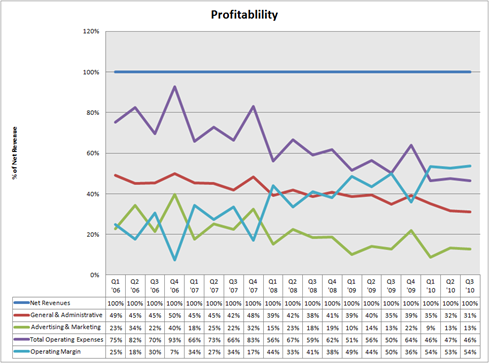
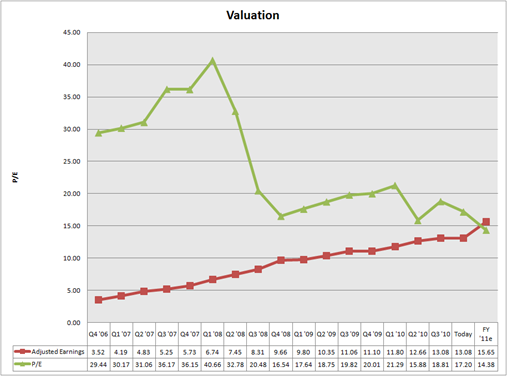
MasterCard is in the business of processing payments and licensing its brand. It does not issue cards or extend credit. Basically it collects royalty on worldwide consumption. The economics of the business are very attractive. It’s in a duopoly position in most markets with its only competitor, Visa. MasterCard’s revenue has grown by 1.6x from $3.3 billion to $5.4 billion in the last 5 years since its IPO in 2006. Revenue is expected to continue to grow at low-to-mid-teen rates as electronic payments take its share from traditional forms such as cash and checks globally. Furthermore, the business requires very limited capital and almost all of it is fixed in nature – in its data centers and for marketing & advertising. These expenditures are growing at a much slower rate than revenues, hence there’s massive operating leverage. Operating margins have expanded from 20% in 2006 to 50% today. EPS has grown faster than revenues and by 3.7x from $3.52 in 2006 to $13.08 today. Amazingly, Mr. Market is offering this “wide moat” business at two-thirds its conservatively assessed intrinsic value because of valid but potentially overblown concerns over the impact of a recently passed regulation called Durbin Amendment.
Business Model: 
MasterCard operates a ‘Four-Party Payment System’ that processes information and routes transactions between the cardholders’ and merchants’ financial institutions in fractions of a second. It is so called because the network links together the four parties involved in each transaction:
  • The cardholder’s issuing bank, also known as the issuer, that markets and issues payment cards to the cardholder.
  • The cardholder who can use his payment card almost everywhere in place of traditional forms of payment such as cash or check.
  • The merchant who accepts the payment card in exchange for goods or services and receives guaranteed payment.
  • The acquirer that contracts with the merchants and provides them with payment card acceptance and processing services.
Flow of transaction information begins with the purchase, when the cardholder provides the payment card information to the merchant. The merchant sends the card information to the acquirer, such as First Data,  through its point-of-sale terminal, which in-turn passes the information along to the issuer, such as Bank of America. Card networks, such as MasterCard, typically provide the link between acquirers and issuers over which this information flows. The network routes information first to authorize and then to settle the payment. To settle, the issuer obtains funds from the cardholder  - $100 in this example – which it can pay the acquirer. However, the issuer retains a portion of the funds an an “interchange” fee. In this example, the fee is $1.50 and the issuer send $98.50 to the acquirer. The acquirer charges the merchant a processing fee, “merchant discount fee”, of $0.50 and deposits $98 in the merchant’s account. The merchant service charge is the total cost of processing the payment and in this example is $2. The card networks do not get compensated from the interchange fee or the merchant discount fee. They usually charge the issuer and the acquirer various network usage fees based on many factors that are not clearly disclosed, but whose key drivers are the gross dollar volume and the number of transactions flowing through their network. In general, the network fees amount to tiny fractions of the interchange fees and the merchant discount fees.
FourPartySystem
Like MasterCard, Visa also uses a ‘Four-Party Payment System’. Transactions on the other two major card networks – American Express and Discover – generally involve only three parties: the cardholder, the merchant, and one company that acts as both the issuing and the acquiring entity. Merchants that choose to accept these two types of cards typically negotiate directly with American Express and Discover over the merchant discount fees that will be assessed on their transactions.
In a ‘Four-Party Payment System’, the interchange fees generally account for the largest cost of acceptance of the payment cards. Even though these fees are earned by the issuer, they are set by the card networks. This may sound surprising to those who are not familiar to the payment card market, but economists have noted that the payment card market is an example of a “two-sided” market. In such a market two different groups – merchants and consumers – pay different prices for goods offered by a producer.
Other two-sided markets include newspapers, which charges different prices to consumers who purchase the publications and advertisers that purchase space in the publications. Typically, newspapers offer low subscription rate or per copy price to attract readers, while funding most of their costs from revenue received from advertisers. Charging low prices to encourage large numbers of consumers to purchase the newspaper increases the paper’s attractiveness to advertisers as a place to reach large number of consumers, and thus allow publishers to charge such advertisers more.
Similarly, the card networks use interchange fee as a way to balance demand from both consumers (who want to use cards to pay for goods) and merchants (who accept cards as payment for goods). As with newspapers, the cost to both sides is not borne equally. To attract a sufficient number of customers to use their cards, card networks compete to attract financial institutions to issue them (by compensating them through the interchange fee). Just as readers have a variety of sources from which they can receive their news, consumers also have a number of different methods (such as cash, checks, or cards offered by various issuers) by which they can pay for goods and services. The financial institutions compete to attract consumers to use the card issued by them by charging them a low fee or often offering them a negative cost through rewards. This price structure is critical to encourage the consumers to carry the  network’s cards in place of cash and checks. Once the circulation of cards for a particular network goes up, network effects kick-in, leaving merchants with limited choice but to accept the network’s payment cards. Like the case of advertisers in the newspaper market, the revenue for funding the costs of this system is mostly provided by the merchants. Unlike the advertiser’s case, the benefits that the merchants receive for participating in this system may not be obvious to you. Here is a list:
  • Less vulnerable to theft and can provide safer workplace to employees.
  • Faster and guaranteed payment for transactions (unlike checks).
  • Faster checkout.
  • Benefit of increased sales as more people are attracted to stores that accept their card.
  • Is more cost-effective than merchants issuing their own cards or some other form of credit.
  • Easy record keeping
As merchants acceptance for a network’s card goes up, issuers’ preference for the network also goes up. This is evident from the fact that Visa and MasterCard have dominated the credit card purchase volume for years, and it has been very difficult for Discover to gain a higher market share. The above attributes of the business model makes both, Visa and MasterCard, a “wide moat” business.
Business Overview:
The card-based forms of payments licensed by MasterCard fall in the following categories:
  • "Pay Later” Cards that allow the cardholder to access a credit account (Credit)
  • “Pay Now” Cards that allow the cardholder to access a demand deposit or current account (Debit)
    • Signature based debit card – primary means of validation is signature at point-of-sale
    • PIN based based debit card – primary means of validation is a PIN at point-of-sale
    • Cash access ATM card – access cash at ATMs by entering a PIN
  • “Pay Before” Cards that allow the cardholder to access a pool of value previously funded (Prepaid).
In general, credit cards carry the highest interchange fees, PIN debit the lowest, and signature debit and prepaid cards in between. As a corollary, credit cards usually carry the highest rewards for the consumers and the PIN debit cards the lowest.
MasterCard generates revenues by charging its customers (issuers and acquirers) fees for providing transaction processing and other payment-related activities and assessing its customers based on the dollar volume of activity on the cards that carry their brands. Their net revenue is categorized in five categories:
  • Domestic assessments: Based primarily on the volume of activity on the cards where the merchant country and the cardholder country are the same.
  • Cross-Border volume fees: Based primarily on the volume of activity on the cards where the merchant country and the cardholder country are different.
  • Transaction processing fees: Charged for both domestic and cross-border transactions and are primarily based on the number of transactions.
  • Other revenues: Examples of other revenues are fees associated with fraud products and services, consulting and research fees etc.
  • Rebates and incentives: Varies based on type of rebate and incentive – hurdles for volumes, transactions or issuance of new cards etc.
MasterCard’s pricing is very complex and is undisclosed, but it depends on the following factors:
  • Domestic or Cross-Border.
  • Signature-based or PIN-based. Signature-based generates higher revenue.
  • Tiered-pricing with rates decreasing as customers meet incremental volume/transaction hurdles.
  • Geographic region or country.
  • Retail purchase or cash withdrawal.
Financials: 
Net Revenue has compounded at an average quarterly rate of 4.5% in the last 15 quarters since Q1 ‘06. Note that revenue from international transactions (Cross-border volume fees) is becoming a bigger percentage of the overall revenue as seen in the revenue breakdown chart below.
RevenueBreakdown
Revenue growth can be attributed to two key drivers (i) gross dollar volume flowing through the network and (ii) number of transactions processed. GDV attributed to credit in the US is slowing whereas debit in US as well as rest of the world (ROW) has been growing rapidly. Also, GDV flowing from rest of the world is a much higher percentage today than in 2006. GDV grew quarterly at an average compounded rate of 3.2% and transactions at an average compounded rate of 3.4%. The faster revenue growth can be attributed to higher cross-border volume transactions and/or pricing changes.
KeyDrivers
MasterCard is among the most profitable businesses in the world. Because of the predominantly fixed cost nature of its business, it has massive operating leverage that is evident in the chart below. Operating expenses have come down from 75% of net revenue to 46%. In the long-run, MasterCard should be able to maintain operating margin in the range of  40-50%.
Profitability
These numbers are based on adjustments made to income statement. To make these adjustments, we ignore one-time events (gains as well as losses) and litigation costs. Even though we ignore litigation costs, it is expected to be an on-going cost and cannot be ignored in our future outlook or valuation of the business. It helps to do so here only to highlight the operating nature of the business.
Adjusted Income Statement
MasterCard has a pristine balance sheet with no debt and $3.7 billion of cash and securities ($29 per share). It has reserves for pending obligation settlements and for off-balance commitments for leases and sponsorships. Adjusting for these ‘debt-like’ liabilities, it has excess cash & securities of $20 per share.
BalanceSheet
Valuation:
Mr. Market has offered this wealth compounding machine at low valuations as today only a few times before in its trading history – (i) during the great recession in 2008 and (ii) in Q2-Q3 ‘10 when a law to regulate the interchange fees and the payment card business was passed (also known as the Durbin Amendment – more on this later).
Valuation
P/E ratio of 17.20x in the chart above in the 'today' column does not take into account the excess cash on MasterCard’s balance sheet. Taking out the $20 excess cash from the price for MasterCard share of $225 today gives a lower P/E ratio of 15.6x. For a business with growth prospects and profitability like MasterCard’s, it ought to trade at least at a P/E ratio of 18-20x + excess cash on balance sheet.  We believe this will require patience though. Once the regulatory clouds clear and MasterCard can prove that it can manage through Mr. Market's current concerns, Mr. Market will award MasterCard’s shareholders by expanding its P/E ratio to this range (or even higher depending on its mood). This is very similar to Mr. Market’s response from Q4 ‘08 at the peak of the recession through Q1 ‘10. The matrix below shows the skewed risk-reward profile for investing in MasterCard today. We agree that it was cheaper in Q2 ‘10 when it hit a low of $191, but I believe that today's price offer a good enough margin-of-safety. Timing the market is not a value investor’s forte. We would rather take Mr. Market’s offer today to build a position and be ready to average down our purchase price in case of further volatility.
Risk-Reward Matrix
Durbin Amendment:
Why is Mr. Market unenthusiastic about MasterCard today? The reason - a particular amendment, “Durbin Amendment”, to the Dodd-Frank Act Wall Street Reform and Consumer Protection Act that was passed by the Congress in the summer of 2010. For those not familiar with the Dodd-Frank Act, its main provisions are aimed squarely at large banks and other systemically important financial institutions in response to the recent financial crisis. The Durbin Amendment has provisions that aim to regulate the credit and debit business in the US. Interchange fees and related payment card network rules have been the subject of intense regulatory scrutiny and litigation globally for the past decade. The Durbin Amendment marks the first time these fees will be regulated in the US.
This section of the article is broken into the following sub-sections: (I) Why regulation (ii) What is Durbin Amendment (iii) Fed’s proposal (iv) Possible Impact of the Proposal.
(i) Why regulate the interchange fees?
Why regulate the interchange fees? US interchange fees are the highest in the world. The total amount of interchange revenue from credit and debit transactions is unknown but it is estimated to be about $48 billion. As per one estimate we have read, roughly $31 billion is from credit interchange and $17 billion from debit interchange. The chart below shows the breakdown further:
USMarketSharePayments
As per the GAO report on the interchange fees, one of the reasons for the rise in the interchange fees is increased competition among card networks for financial institutions to issue their cards. Although increased competition generally produces lower costs for goods and services, such is not the case for this market. Before 2001, Visa and MasterCard had exclusionary rules prohibiting their members institutions (they were an association then, not a private or a publicly-owned enterprise and their members were also the issuers) from issuing cards of the competing networks. In 1998, DOJ initiated a lawsuit charging, among other things, that Visa and MasterCard had conspired to restrain trade by enacting and enforcing these exclusionary rules. The trial court held that Visa and MasterCard had violated section 1 of the Shearman Antitrust Act by enforcing their respective versions of the exclusionary rule. As a result of the court’s decision, an issuer of one of these network’s cards has the option to issue cards of any other network (a Visa issuer could now issue MasterCard, American Express, and Discover cards). Network officials from Visa told the authors of the GAO report that they actively compete to retain the issuers on their network and interchange fees play an active role. Government intervention in this market led to an unintended side effect of increased interchange fees, and raising the cost of accepting the cards even further rather than lowering it. According to the GAO report analysis of Visa and MasterCard’s interchange fee schedules, several of the networks highest interchange fees were introduced after this decision.
Furthermore, payment card networks maintain a number of rules related to the terms on which merchants accept cards. The rules, which vary between the networks, generally require the merchants to accept all of the payment card networks’ cards in all of their locations on all of their transactions (no minimum and maximum purchase amounts) and to route the clearance of all transactions made using the network’s cards through their network. The rules also forbid merchants to discriminate among the networks’ cards (including surcharging or differentiating between their basic cards and reward cards), or against the payment card network in favor of other card networks. Merchants argue that payment card network rules forbid them from passing along interchange fees to card users, a large portion of the fees are ultimately passed to all consumers in the form of higher prices. Merchants and consumer advocate groups also content that interchange fees are competitively high because merchants can neither bargain over the fees nor pass them along to the card users.
Thus, many merchants find that the cost of accepting payment cards is one of the fastest growing costs of doing business and one that they can do little to control. While merchants receive many benefits for accepting payment cards as we discussed in the business overview section, there is a threshold to merchants’ price elasticity. Accordingly, US merchants have brought litigation and have pushed hard for a legislative solution to what they perceive as an unfair interchange system that enriches the financial institutions at their expense and their consumers’. The Durbin Amendment is the most substantial reply to their campaign to-date.
(ii) What is Durbin Amendment ?
The Durbin Amendment aims to improve competition among payment card networks by reducing the interchange fees on debit cards and allowing merchants greater ability to steer transactions towards lower-cost payment systems.
The legislation contains two operative sections. One section only addresses debit cards. The other section addresses all payment cards, credit and debit.
(i) The first part of the amendment requires that the interchange fees on debit card transactions be “reasonable and proportional to the cost incurred by the issuer with respect to the transaction.” The amendment instructs the Federal Reserve to promulgate regulations for assessing whether interchange fees are indeed reasonable and proportional to the cost incurred by the issuer with respect to the transaction. In determining what fees would be “reasonable and proportional” the amendment directs the Fed to consider the similarity between debit and check transactions that it requires to clear at par. The amendment also provides in its rule making, the Fed shall only take into account issuers’ incremental costs for debit transactions; thereby excluding fixed costs like distribution and other overhead. The Fed is permitted, however, to adjust for issuers’ net fraud prevention costs. The Fed is also permitted to regulate the network fees to ensure that they are not used to reimburse issuers directly or indirectly. Small issuers with less than $10 billion in consolidated assets are exempt from the “reasonable and proportional to cost” requirement, as are government-administered payment cards, and prepaid reloadable debit cards that are not gift cards or gift certificates. The $10 billion exemption is not inflation indexed.
(ii) The second operative part of the amendment prohibits certain payment card network rules that restricts merchants’ ability to steer consumers towards particular payment systems. The small issuer exemption does not apply to this part of the amendment.
(a) First, the amendment prohibits exclusive arrangements for processing debit card transactions. The provision requires that every electronic card transaction be capable of being processed on at least two unaffiliated networks, enabling what is known as “multi-homing (meaning every transaction can find its way “home” over multiple network routings). The requirement that at least two unaffiliated debit networks be able to process each transaction opens the door among networks for transaction processing.
(b) Second, the amendment prohibits the networks from restricting merchants’ ability to decide on the routing of debit transactions. Combined with the multi-homing requirement, this permits merchants to route payments to the networks to the debit network offering them the lowest cost, rather than the current system. This means that card networks will have to compete with one another for merchant routing, presumably resulting in lower interchange fees.
(c) Third, the amendment prohibits payment card networks from preventing merchants from offering discounts or in-kind incentives for using cash, check, debit, or credit so long as the incentives do not differentiate by issuer or networks. The provision specifically does not authorize surcharging, which most card networks prohibit.
(d) Finally, the amendment prohibits payment card network rules that forbids merchants from imposing minimum and maximum transaction amounts for credit cards. Henceforth, merchants will not be violating network rules by refusing to accept credit card transactions below $10, and federal agencies and higher learning institutions may impose maximum amounts. The amendment does not affect payment card network rules’ forbidding minimum transaction amounts for debit cards. There is no exemption from the second part of the amendment for small issuers.
The Fed is required to prescribe the regulations implementing “reasonable and proportional to cost” provision of the Durbin Amendment by April 2011. The Fed is also required to prescribe regulations regarding the multi-homing requirement by July 2011. These provisions of the Durbin Amendment are not self-executing without the Fed’s rule-making. The discounting and authorization of minimum and maximum amounts of credit transactions were effective as of the signing date of the Dodd-Frank Act, on Jul 21, 2010.
(iii) The Fed’s proposal:
On Dec 16 2010, the Fed put the proposed rule-making out for comment and notice before it's Board can  vote on the proposed rule. Comments are due by Feb 22, 2011.
MAStockDrop
During the period from Dec 13 to Dec 23, MasterCard’s stock dropped by 17% from a high of $260 to $216.
"Reasonable and Proportional to Cost" Requirement: The Fed, in its proposal, is requesting comments: one based on issuer’s costs, with a safe harbor (initially set at 7 cents per transaction) and a cap (initially set at 12 cents per transaction); and other a stand-alone cap (initially set at 12 cents per transaction). The Fed did not propose any adjustment to the interchange fee for fraud prevention costs. In order to prevent circumvention or evasion of the limits on the interchange fee that issuers receive from the acquirers, the Fed’s proposed rule prohibits an issuer from receiving net compensation from the networks. If the Fed  adopts either of the proposed standards in the final rule, the maximum allowed interchange fee received by the covered issuers for debit card transactions would be more than 70% lower than the 2009 average, once the new rules take effect on Jul 21 2011.
"Multi-Homing" Requirement: The Fed, in its proposal, is requesting comments on two alternate approaches: one alternate would require at least two unaffiliated networks per debit card. For example, a MasterCard signature debit card cannot have a MasterCard branded PIN on the back of the card, but it can have Visa 's Internlink or Discover's PULSE branded PIN). The other alternate would require at least two unaffiliated networks per debit card for each type of cardholder authorization method. For example, each card has two unaffiliated brands for signature debit transaction and two unaffiliated brands for PIN debit transaction. Under both alternatives, the issuers and the networks would be prohibited from inhibiting a merchant’s ability to direct the routing of debit card transactions over any network that the issuer enabled on the debit card.
(iv) Possible Impact of Durbin Amendment
I hope to impress upon you that the impact of the Amendment on MasterCard will be manageable, and that the analysis in the valuation section continues to be valid.
As part of the Fed’s proposal, the Fed required financial institutions to submit data that would help them comply with the Amendments “reasonable and proportional to cost” provision. Examining this data shows that the fees that the networks make on a per transaction basis is fractions of the total of interchange fee and merchant discount fee. For signature debit, the average interchange fee is 56 cents and net (accounting for per-transaction fees, non-transaction fees, and rebates and incentives) network fee per transaction is 5.9 cents for issuers and 4.5 cents for acquirers. For PIN debit networks, the average interchange fee is 23 cents and net network fee per transaction is 1.9 cents for issuers and 3.2 cents for acquirers. However, these numbers are even lower for the large issues because of the rebates and incentives they receive from the networks. Even though, it seems that the Fed’s proposed rule to cap the interchange fee will put pressure on network’s fee charged to the issuer, it seems quite unlikely that this will have a large impact on the networks. Network fees as an overall percentage of the issuer’s total gross interchange revenue today is quite small. Given the statistics from the Fed’s survey, network fees only account for 10% on average but smaller than 5% for the large issuers, who control 70% or more of the debit market. Thus, if these issuers are able to replace their lost interchange revenues from other areas and continue to be interested in maintaining the debit product, network fees will be relatively inelastic to the reduction in interchange fee.
The question then is whether banks will continue to issue debit cards and maintaining a debit card portfolio. Listening to payment card experts, I have learnt that the debit card is not yet another product in the bank’s portfolio. The debit card is an interface to the checking account. In fact, checking account is a misnomer. It should really be called a debit account. The banks aka the issuers have an incentive beyond the interchange fee to maintain the debit card product. It is an important relationship management tool required to attract cheap funding through deposits. In light of the reduced interchange fee, the banks will figure a way out to replace the lost revenue through other sources.
“If you can’t charge for the soda, you’re going to charge more for the burger” –Jamie Dimon, CEO, JP Morgan Chase.
“We’ll go back to where we were 20 years ago where there will be kind of a certain number $5, $8, $9 stated charge for having a checking account every month.” –Kelley King, CEO, BB&T.
“Our goal in the thing is to at least make the thing revenue neutral” –William Cooper, CEO, TCF Financial.
Also,  banks will look to alternate products to replace lost revenue like prepaid cards whose interchange fee is unregulated. The economics of higher interchange fees could cause its circulation to go up. Up until now, the banks weren’t too interested in the prepaid product. It was left to merchants like Walmart and H&R block. But the Durbin Amendment may change this situation going forward. Banks could steer its small customers to the prepaid product by levying a hefty charge if checking account dips below a threshold amount and showering awards for using a prepaid card. In such a scenario, MasterCard is positioned better than the other networks to take advantage of the possibility.
Next, let’s understand the impact of the two multi-homing alternates. If the first alternate is chosen, then the cost of processing a transaction (interchange fee + merchant discount fee) on a signature debit will not compete with that of the unaffiliated PIN debit. Off the 8 million merchant locations, only 2 million accept PIN debit. Also, E-commerce merchants and merchants like hotels and car rentals usually only accept signature debit cards. So, in these locations, the merchant has no choice but to accept the signature debit. The first alternate will have virtually no impact on these transactions. At the other 2 million locations that accept signature as well as PIN, the cost of processing a transaction will compete to a certain extent with the PIN transactions but only if the differential between the two is large enough. However, with the interchange fee being capped and acquirer market being competitive, the differential between the total cost of processing a signature transaction and a PIN transaction will be compressed. Even if the networks chose to pass the network fee revenue that they lost on the issuer-side to the acquirers (who in turn will pass them on to the merchants), the total processing cost of signature and PIN would be very close. Merchant's would lose the motivation to provide incentives to steer customers from signature to PIN. PIN simply will start to lose its attractiveness among the remaining 2 million merchants that use it. In the next cycle of upgrades, we think that many merchants will skip upgrading their PIN pads. As this occurs, the mix between signature and PIN should tilt further towards signature benefitting MasterCard (and Visa and Discover). Hence,  I believe that the networks will be well protected in the big picture.
The second alternate to multi-homing seems very unlikely. Even the Fed officials  (as expressed in the proposed rule-making) think that this alternate is impractical. Implementing this alternate requires significant investment and time required to educate all the parties of the payment card system. Further, it could arguably cause fraud occurrences to go up and weaken its appeal as a product harming the consumers, which is not the intent of the rule-making.
The first alternate, the one that is likely, impacts PIN routing on the signature debit cards. As an example, vast majority of Visa’s debit issuers have exclusive PIN routing contracts with Visa’s PIN brand – Interlink. The first alternate to the multi-homing provision requiring each card to have two unaffiliated networks on the card, opens up the exclusive PIN network contracts on the signature card for competition. Luckily for MasterCard, this is one of those instances where not being a market leader is a good thing. Visa is the market leader in PIN debit, whereas MasterCard is not even in the top four. Thus, MasterCard has a more to gain than to lose due to this aspect of the provision. It could help MasterCard gain market share in this area, but it is a low yielding business so it probably does not matter in the big picture.
Lastly, the provision that merchants can discount any payment card transaction may have negative impact on MasterCard’s US credit card business. It seems like a possibility, but the fact that merchants cannot surcharge dims the likelihood. Mathematically speaking they are the same, but discounting causes a consumer behavior that is a lot less pronounced than surcharging. Besides, merchants have thinner margins and may not be able or want to provide cash discounts. The possible incentives could be a dedicated debit line or coupons. The minimum and maximum limits may reduce the number of transactions but its hard to quantify the impact it may have on MasterCard’s US credit business.
The important conclusion from the above discussion is that the concerns about Durbin Amendment as it applies to MasterCard seem overblown. The losers in this case seem to be the community banks and the consumers. You may ask why community banks if they are exempt from interchange fee cap, but I will leave that discussion to some later time.
Risks: MasterCard is facing litigation in many countries globally. Management thinks that pending litigation that can have meaningful impact have already been reserved on the balance sheet (and we excluded them in our calculation of excess cash & securities). However, if any of the litigations had an unexpectedly large negative outcome, MasterCard’s equity could get wiped out. Also, regulation like one in the US in the debit card business or in its international activities could negatively impact its business and earnings power.
Disclosure: Long MA. This is not a recommendation to buy or sell any security. Please do your own research before taking any action regarding any security mentioned in this article. The author takes no responsibility for any errors in this article.
Resources:

Wednesday, November 3, 2010

What Todd Combs and I have in Common: Leucadia National Corp.

Recently, Todd Combs, a 39 year old hedge fund manager, was named by Berkshire Hathaway to manage a "significant portion" of the company's investment portfolio. Mr. Combs has been managing Castle Point Capital, a Greenwich based hedge fund for the past five years. Today, not much is known about him or his hedge fund, but we can look at Castle Point Capital 13-F SEC reports and learn of his investments. Between March 31, 2010 and June 30, 2010, Mr. Combs purchased 4 new names and added to a few of his existing positions. One of the 4 new positions is in a company called Leucadia National Corp. (NYSE:LUK). He purchased 255,000 shares at an average cost of $23.36. Coincidently, I too purchased Leucadia for my portfolio around the same time at an average cost of $19.97. 

Leucadia, under the leadership of the Chairman Ian Cumming and the President Joseph Steinberg, went from a failing company to a huge success today. Over the last 30 years (1979-2009), it's book value has compounded at 18.5% and its stock price has compounded at 21.4%.


What does Leucadia do? Here is what their 1988 letter to shareholders says:
"We tend to be buyers of companies that are troubled or out of favor and as a result are selling substantially below the value which we believe are there. We then work at improving the acquired operations with a view to increasing cash flow and profitability. From time to time we sell parts of these operations when prices available in the market reach what we believe to be advantageous levels. While we are not perfect in executing this strategy, we are proud of our long-term track record. We are not income statement driven and do not run your company with an undue emphasis on quarterly or annual earnings. We believe that we are conservative in our accounting practices and policies and that our balance sheet is conservatively stated."
Leucadia has no quarterly calls, no earnings guidance, and no Wall Street analysts that follow it. One of the main reason is that Leucadia has very few operating companies. It is really a hodge-podge of assets that are usually a work in progress. In this article, I would like to highlight a few of the transactions they have done over the years. The main source for this information is their Buffett-like letters to shareholders. Mr. Cumming and Mr. Steinberg are a great example of control investors that have a value investing approach.

Insurance
In their 1991 letter to shareholders, Leucadia reported that they acquired Colonial Penn Insurance companies, a property & casualty insurer, for $127.9 million in cash. This was a great bargain purchase, since Colonial Penn had $391 million in book value. These companies had been for sale a long time and the selling price had come down to an attractive level. The problem was a portfolio of casualty insurance risks in niche markets that appeared very scary. Leucadia did an exhaustive due diligence and determined that this portfolio was properly reserved and made the purchase. Here is an excerpt about their core operation from Leucadia's 1992 and 1993 letter to shareholders:
"The direct marketing operations of Colonial Penn, prior to our acquisition, were too expensive. During 1992, we adopted a new, lower cost marketing strategy. Although this resulted in lower volume for 1992, we are pleased with the new structure cost structure and with the increasingly profitable premium volume that we hope will result. Our objective on an ongoing basis is a combined ratio of 100%." 
"A combined ratio of 100% means that premiums equal the sum of claims, related expenses, and underwriting expenses. Thus, if the combined ratio is 100% or less the shareholders keep the after tax earnings on the invested reserves and equity, which can be quite substantial."
This is my kind of insurance company - one that strives for profitability not market share or volume. In 1993, they list their guiding principles for managing the insurance companies.
  1. We are driven by a search for profitability, not for volume or market share and, as a result, sometimes the best strategy is to retreat.
  2. We would rather reserve conservatively and be required to release reserves than to under reserve and be required belatedly to report loss.
  3. We search for niches, not dominance, on the theory that the world can tolerate many mice but few elephants.
  4. We invest the portfolios conservatively. We are willing to give up marginal yield for predictability, safety, and a good night's sleep. This general conservatism helped us survive the '80s. There is no such thing as a free lunch - either it isn't lunch or it isn't free.
  5. We face the responsibility of managing so much of other people's money with constant vigilance and trepidation. The insurance reserves do not belong to the shareholders, only the capital does. 
  6. We invest in shorter maturity bonds. In the long run, stocks do better but over shorter periods of time they are not predictable. The obligations to our insureds are predictable. We best fulfill our obligations by investing in bonds.
  7. We are afraid of long-term bonds.
  8. We do not invest the insurance portfolios in uninsured real-estate, junk bonds or exotic securities.
  9. We do not reinsure other insurers risks. Our plate is full with our own risks.
  10. We increase our shareholder's wealth by buying businesses at the right price - not by speculating in portfolio securities.
In 1996, Leucadia reported that they sold Colonial Penn, after successfully turning it around. Their comments in the 1996 letter to shareholders gives an insight into their sell discipline:
"Since we bought Colonial Penn companies in 1991 for $127.9 million, they have been ably managed by ... Together, we have worked hard to make these entities more profitable. The companies have paid to Leucadia tax-sharing payments, management fees, interest and dividends totaling $300 million. This, plus the proceeds from the sales, adds up to approximately $1.77 billion pre-tax. This is a remarkable result and a significant return on investment, approximately, 75% per annum.
In the venture capital business, where we began our careers, we developed the belief that the science is in investing and the art is in selling. Art in the sense of the ineffable human ability to collect and integrate vast amounts of unrelated information and in some mysterious way arrive at an opinion as to whether to hold or sell. Over the years, we have learned to depend upon this process.
In deciding whether or not to sell Colonial Penn companies, we availed ourselves to both science and art. Our personal thinking went something like this. Colonial Penn Property & Casualty sells auto insurance direct to the consumer. Current conventional wisdom is that direct marketing of insurance is the wave of the future. Direct marketing companies are much in demand and lots of money is pouring into the business. GEICO, General Electric, Progressive, and others will become ferocious competitors. When the giants start to rumble, price pressure cannot be far behind. Large marketing expenses in the hope of establishing large market share and profitability is not our forte. Too much capital flowing into market niches makes for a miserable, frustrating experience.
Since auto insurance is not a particularly growing market, the only place to get new customers is from a competitor. We are afraid that in the future making money in the auto insurance business will be like picking pennies in front of a steamroller - dangerous and not significantly rewarding. For a total of over one billion dollars, 2.6 times GAAP book, 3.2 times statutory book, and 24.1 times after-tax earnings, a sale was the better part of valor."
Lending
Leucadia conducted its banking and lending activities through its national bank subsidiary, American Investment Bank (AIB). Here is an excerpt about this operation from their 1995 and 1996 letter to shareholders:
"AIB primarily offers auto loans to people with bad credit reports. We have done quite well with the program over the years and offer this service in 14 states throughout the country. In the last couple of years, significant competition began to enter the market. Several large, well financed institutions began to enter the market or bought competitors (at very large premiums) and several initial public offerings were funded. The competition has become increasingly intense, rates have fallen in the market and loan losses are up. From the borrowers point-of-view the choice is simple, go with the lower rate. We have decided not to lower rates but to let business shrink. As a result, our volumes have fallen significantly. We have seen the arrival of inexperienced money before. This is a difficult business. Higher rates are required to make money. Over the next few years we hope that the competition will dwindle and our volumes will slowly return. If not, we will go onto something else. We have no desire to be a slender lender, a lender at inadequate rates."
"[1996] One depressing tangible illustration of the current state of consumer banking is the number of mailers each of us receives offering credit cards, home equity loans, and unsecured lines of credit. In our view, the consumer banking business has become very competitive and the returns do not warrant the risk. Lenders are in a bidding war to convince customers at virtually every income level to borrow more and more. The easy access to credit allows borrowers to control their debt ratios to an unprecedented degree. Not surprisingly, we now read of skyrocketing delinquencies and bankruptcies.
These trends have hit our auto program especially hard. In keeping with the plan we announced last year, we are shrinking our portfolio rather than chase after business with inadequate rates ans excessive losses. Most of our competition securitizes their loans. As capital markets respond to the poor performance of the loans backing these securities, we expect funds available in the market to dwindle and rates to rise. Until then, we intend to approve loans cautiously, make prudent program changes, increase our loan reserves, closely monitor the debt ratios of our borrowers, and pay even more attention to servicing and collecting our existing portfolio. This will reduce earnings in the short run but will position our lending operations to take advantage of opportunities arising from the eventual shakeout in the industry. We don't expect improvement in the auto loan business in 1997. Three large auto competitors have gone out of business, but there is still no shortage of silly money about. Wall Street has yet to feel the pain; when it does, the business will improve. We maintain the perhaps naive hope that this Alice in Wonderland substandard lending market will return to rationality."
By 1998, rationality begins to return to the sub-prime market. In their 1999 letter to shareholders, they report:
"Several players who thought they could defy financial gravity ended up in bankruptcy. The acquisition in late 1998 of a $36.9 million portfolio of sub-prime auto loans, purchased at a discount, jump started AIB's return to the market.
AIB is actively back in the sub-prime business and generating $300 million in loans per annum from 29 states with an anticipated average life of 22 months. While these loans are not as profitable as in the pre-1995 era, the risk/reward relationship makes sense. We will continue to keep in mind the lessons of the past, and should events warrant, AIB will go back into its cave."
By 2001, the dot com bubble had burst and the economy had turned south. In response, AIB exited sub-prime auto lending. It was the right decision given that the potential reward did not justify the high level of risk.

During the Great Recession of 2007-2008, Leucadia got another opportunity to come back to this business through AmeriCredit Corp. Here is an excerpt about their reentry in this business from their 2007 and 2008 letter to shareholders:
"[2008] We have acquired 25% of AmeriCredit Corp ("ACF") for $405.3 million. [2007] We have known of this excellent opportunity for many years, having been in the sub-prime auto business ourselves. ACF has made and financed over $53 billion of these loans and none of its lenders has lost a penny. In this environment, financing for ACF is going to be very difficult and management is taking appropriate actions to downsize the company. We are guardedly optimistic that the financial market will climb out of its bunker next year. People need auto financing to get to work."
[2008] Years ago we owned a similar business and as a result carefully followed ACF. We observed that their large volume and efficient processing and underwriting abilities made them a fierce competitor. We also observed that when a recession hit ACF when through a period of poor results, but when a recovery began they were able to make large profits by being able to select more credit worthy customers and to charge more for loans.
Much of the above remains true; however, we began to buy the stock too soon and paid too much. The recession has been much harder and much deeper than we anticipated, though ACF is succeeding in acquiring credit worthy customers and is able to charge them higher rates. The fly in the ointment has been that is has been almost impossible to secure additional funding to make loans. Securitizations, which were the lifeblood of their funding, has been in rigor mortis. The Federal Reserve has announced a program to restart consumer funding called TALF, but as yet TALF has not been able to access it. Perhaps that will change. ACF has enough funding to operate at a much reduced volume and is committed to preserve its net worth of $15.03 per share. We have a high regard for its management."
In 2009, Leucadia reported its status on the ACF investment:
"In spite of the financial disaster, these investments [ACF and others] performed as expected - beautifully. As in much of life, ACF's secret to success is discipline. Currently, competition has lessoned and ACF can earn a fair return for its risk. Eventually banks and other folks will come rushing back into the market, margins will fall as evaluation of risk becomes, yet again, ignored and volume will become the sole focus of competitors as a means to impress the Stock Market. When that day comes, we hope that ACF will eschew volume, efficiently harvest its portfolio and watch the lemmings as the launch off a cliff. Then the cycle will begin anew. We have a great relationship with, and respect for, the management team. We believe they are the best in the industry."
In July 2010, GM announced its acquisition of ACF for $3.5 billion. Leucadia's share will be $875 million - close to 30% return per annum. Pretty sweet, given that Leucadia thought that they acquired ACF too early and paid too high a price. At one point, Leucadia's investment in ACF was down to $180 million from its investment of $405 million. Value investors don't need to time the market to do well !

Shareholder-Friendly Management
The Chairman and the President together own about 25% of the outstanding shares. Their actions in the past clearly indicate that their interests are aligned with those of the shareholders.

When asset prices were rising in the late nineties, they wrote the following in their 1997 letter to shareholders:
"Higher prices inevitably mean lower returns. The consequence of miscalculation or mistake become more deadly as prices increase. Extreme caution is in order. There is a vast amount of money sloshing around the world. As hard as we run [around the world], the hot money has beat us there. One of us predicts a very unhappy ending to this exuberance; the other doesn't know what to think. This is a conundrum. Several alternatives are available:
  1. Do nothing. Keep our cash short and safe and wait until the old world returns. In the meantime, low returns are guaranteed.
  2. Do the above, but give shareholders back a significant portion of their money. Perhaps individually you can do better than we think we can. At least we will worry less.
  3. Stop the merry-go-round and give all the money back on the theory that a 20 year run is a good one; the old world is unlikely to return soon, but for certain it will not be in the same form. These dogs may be too old for new tricks.
  4. Some combination of the above." 
Finally, in 1998, when they had more money than ideas, Leucadia returned $812 million, or $13.48, to shareholders in the form of a special dividend. The compounding of 18.5% in book value does not include this special dividend. 

In April 2008, Leucadia's stock was north of $50. It was trading at a large premium to its book value. Mr. Cumming and Mr. Steinberg took advantage of this situation and sold 10 million shares at $49.83 to an investment bank Jefferies & Company. In return, Leucadia received 26 million shares of Jefferies and $100 million in cash. Jefferies sold the 10 million shares of Leucadia and fortified its balance sheet. Wow! Not satisfied, Leucadia used $396 million to further increase its position in Jefferies to 48.5 million shares through open market purchases. At the end of it all, Leucadia owned 30% of Jefferies. Here is an excerpt about Jefferies from their 2008 letter to shareholders:
"Jefferies is not in trouble, not a ward of the U.S. Government, not burdened by toxic assets and not over-leveraged. Its employees own a substantial interest in the firm and their pay interests are being managed with the best interests of the firm in mind. Jefferies has successfully hired talented individuals from troubled or failing institutions and recently acquired a muni and underwriting business. Trading volumes have been good, their restructuring business is busy, but their capital markets and acquisition businesses remain lethargic. This will inevitably improve, but timing is uncertain. We have known Jefferies for a long time and are particularly fond of and hold in high regard its long time CEO, Richard B. Handler. We believe that over the long haul Jefferies will survive and grow to enrich our shareholders !"
As of December 2009, the fair market value of their position in Jefferies was worth $1.2 billion dollars.  Taking into account the $100 million cash it received from Jefferies, Leucadia effectively used $296 million in cash  to yield an unrealized gain of $900 million. But remember, in the process, it also diluted its shareholders. The question is whether dilution created value for its shareholders ? Here is a quick back-of-the-envelope calculation. Prior to the dilution, shareholders had a book value of $24. Dilution reduced book value per share by $1.60, but a gain of $900 million equates to $3.77 per share. Its very rare to see management dilute its shareholders but also create value. One way (maybe this is the only way) it can happen is when management uses its overvalued stock as currency to buy an undervalued asset. That is exactly what Leucadia did.

In addition to these transactions, Leucadia has partnered with Berkshire Hathaway on multiple occasions. Also, recently their investment in an iron-ore operation in Australia has also been very successful. Lastly, I will say that Leucadia has not had to pay a single dollar, or hardly any amount of significance, of tax to the U.S. Government ever. An account of these can be very interesting, but I don't intend to make this article a comprehensive coverage of all the interesting deals Leucadia has done over its 30 year history.

References:
1. Todd Comb's Portfolio, June 30, 2010.
2. Rishi Gosalia's Portfolio, Aug 31, 2010.
3. Letter to Shareholders, Leucadia, 1988.
4. Letter to Shareholders, Leucadia, 1991.
5. Letter to Shareholders, Leucadia, 1992.
6. Letter to Shareholders, Leucadia, 1993.
7. Letter to Shareholders, Leucadia, 1995.
8. Letter to Shareholders, Leucadia, 1996.
9. Letter to Shareholders, Leucadia, 1998.
10. Letter to Shareholders, Leucadia, 1999.
11. Letter to Shareholders, Leucadia, 2001.
12. Letter to Shareholders, Leucadia, 2008.
13. Letter to Shareholders, Leucadia, 2009.